
Most homeowners buy a standby generator and assume the job is done. Set it, forget it, and trust it’ll fire up when the lights go out. But here’s the truth: sitting idle is what kills generators.
A unit that hasn’t been through regular generator maintenance is, in many cases, more likely to fail during a power outage than one that’s been consistently serviced.
This piece covers what weekly self-tests actually accomplish, what a realistic maintenance schedule looks like over the course of a year, and which parts fail first when maintenance gets skipped.
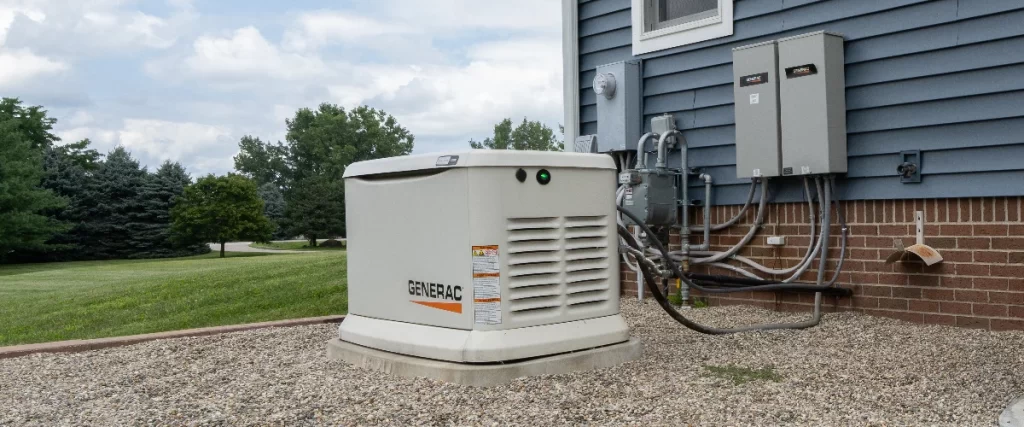
The Biggest Threat to Your Generator
Internal combustion engines weren’t designed to sit unused for months at a time.
When a standby generator goes weeks or months without running, things start going wrong:
- Fuel degrades. Gasoline breaks down, leaving gummy deposits in the fuel system.
- Diesel fuel develops water intrusion, microbial growth, and wax crystallization, particularly in colder months.
- Rubber seals and gaskets in natural gas units dry out over time.
- The battery loses its charge. Most backup generators use a battery, and one that isn’t being trickle-charged or exercised will eventually fail.
- Oil thickens. The coolant level drops without anyone noticing.
None of these is serious on its own, but together they add up to a generator that cranks and sputters the one moment you actually need it.
What Weekly Self-Tests Actually Do

Modern standby generators come with an automatic self-test feature that runs the unit for a short period, usually about 5 to 20 minutes, depending on the model, once per week.
It keeps engine performance stable in several ways:
- Lubricates internal components by circulating oil through the engine
- Charges the battery, keeping it ready to fire on demand
- Exercises the automatic transfer switch, confirming it can move your home from grid power to backup power without issue
- Burns off moisture that builds up in the fuel tank and exhaust system
Think of it like a car parked for six months. Try to drive it, and you’d expect problems. The same logic applies here, whether you have a diesel generator, a natural gas unit, or a propane-powered backup system.
A Realistic Generator Maintenance Schedule
The owner’s manual should always be your first reference. That said, here’s a framework that aligns with what most residential standby generator manufacturers recommend:
| Interval | Task |
| Weekly (automatic) | Self-test run, visual inspection of exhaust vents and air intakes |
| Every 3 months | Check battery charge and connections, check oil level, inspect fuel lines for cracks or leaks, check coolant level |
| Annually | Oil and filter changes, fuel filter replacement, air filter inspection and replacement, spark plug check (natural gas and propane units), full review of documented maintenance log |
| Every 2–3 years | Load bank testing, comprehensive inspection of the electrical system, and transfer switch |
Liquid-cooled models and diesel generators may need tighter intervals. Units in harsher climates or with high operating hours need more frequent attention.
For further reference, NFPA 110, the National Fire Protection Association standard that governs standby power systems, establishes testing and maintenance requirements widely used across the industry. Those same principles apply to residential installations.
Why You Shouldn’t Skip Load Bank Testing
Load bank testing puts the generator under a controlled electrical load to confirm it can actually deliver rated output. A weekly self-test doesn’t load the engine enough to reveal weak points.
A generator that runs fine under light load may still struggle when your air conditioner, refrigerator, water heater, and sump pump kick on simultaneously. Load bank testing catches that before a real outage does.
It’s not something most residential generators need every year if routine maintenance is consistent, but it’s worth doing every couple of years or anytime engine performance feels off.
The Parts That Fail First When Maintenance Gets Skipped
Here’s what actually goes wrong on a neglected backup generator:
- Battery: The most common failure point. A dead battery means the engine won’t start, no matter how good everything else looks.
- Fuel system: Degraded gasoline, contaminated diesel, and clogged fuel filters block the engine from getting what it needs.
- Air filter: A dirty air filter restricts airflow, cuts engine performance, and can cause overheating.
- Oil: Old oil loses its ability to protect internal components. Without regular oil and filter changes, wear accelerates fast.
- Spark plugs: On natural gas and propane units, worn plugs cause hard starts and misfires.
None of these parts is expensive on its own, but costly repairs come when ignored maintenance leads to engine damage.
FAQ
How often does a standby generator need professional service? Most manufacturers recommend at least once a year, with basic checks every three months. Diesel generator maintenance and liquid-cooled models often require tighter intervals based on operating hours.
What happens if the weekly self-test gets skipped or turned off? The battery, fuel system, and internal seals don’t get the regular exercise they need. Over time, that increases the risk of failure during a real power outage.
Can I handle generator maintenance myself? Some tasks are simpler: checking the oil and coolant levels, and performing a basic visual inspection of the exhaust vents and air intakes. More complex tasks, like load bank testing, fuel filter replacement, and electrical system checks, are better handled by a licensed technician.
Does skipping maintenance affect my warranty? In most cases, yes. Manufacturers typically require documented maintenance for warranty compliance. Skipping routine service can void coverage if the unit fails.
How do I know if my generator’s battery is going bad? Slow cranking during a self-test, warning lights on the control panel, or a self-test that fails to complete are common early signs. Annual battery checks are part of any solid maintenance process.
What’s the difference between a self-test and load bank testing? A self-test runs the engine unloaded to keep it exercised and confirm it starts. Load bank testing applies a real electrical load to verify that the unit can deliver its full rated output. Both serve different purposes, and neither replaces the other.
The Case for a Professional Maintenance Plan
Regular generator maintenance is, in the most practical sense, insurance for your insurance.
You bought the unit so it would be there when you needed it. Consistent care is what makes that investment actually reliable.
At Crosswyre Electric, our annual maintenance plan covers a full inspection by a trained technician: reviewing the control panel, checking for fluid leaks, testing the battery, inspecting the electrical system, and confirming the automatic transfer switch is functioning correctly.
For generator maintenance done right, call us at (610) 214-2179 or message us here. Our generator installation page also walks through how installations are done and what ongoing care looks like from the start.