
A power surge is a sudden, quick jump in the voltage running through your home’s wiring, well above the roughly 120 volts your outlets are supposed to deliver.
It only lasts a fraction of a second, but that can be enough to cook the delicate parts inside a TV, computer, or a kitchen appliance.
Some surges are big enough to kill a device on the spot. Others are small enough that you never notice while they quietly shave years off the stuff you’ve got plugged in.
Most Power Surges Start Inside Your Own House

When people picture a power surge, they picture lightning, and a nearby strike really can send a massive spike down the lines. But those dramatic hits are rare.
Most of the surges your home sees are internal. It starts inside your own walls when big appliances click on and off all day.
Your air conditioner, refrigerator, well pump, and dryer each pull a hard jolt of power the second their motors start, sending a small ripple back through the circuits.
Any one is minor, but they happen constantly, and over the years they add up.
The rest come from outside your walls, and they’re worth knowing:
- Lightning strikes and storms, which hit the lines directly or push a surge in from a strike nearby.
- Power coming back after an outage, when the grid re-energizes and floods the lines at once.
- Old or loose wiring, common in older Lehigh Valley homes, which makes every small surge worse.
- Utility work on the grid, like switching and fault repairs, which sends spikes down the service line.
What a Power Surge Does to Your Electronics
When voltage climbs past what a device was built to handle, the extra energy turns into heat and arcs across parts that were never meant to carry it. That’s what burns out a circuit board.
The obvious damage is instant, where one big surge takes out a TV or a game console in a single shot.
The sneakier damage is slow, where dozens of tiny surges wear on a device for months until it starts glitching, rebooting on its own, or giving out years early.
Warning Signs Worth Catching Early

Power surge trouble usually shows up in small ways before an appliance dies.
Watch for a few things:
- Lights that flicker or dim whenever a large appliance cycles on.
- Warm outlets or a faint buzzing coming from the wall.
- Scorch marks or a burnt smell around an outlet or a power strip.
- Breakers that trip with no obvious reason.
- Clocks and electronics that reset themselves at random.
If a few of these are showing up together, especially the burnt smell or the scorch marks, that’s the moment to have your wiring checked by a professional electrician.
Our electrical preventive maintenance checklist shows what a real once-over covers.
How to Protect Your Devices From Power Surges
Protecting a home from power surges works best in two layers.
The plug-in surge protector strip under your desk is the layer everybody knows. It guards one spot; it’s rated in joules for how much it can soak up. But here’s the part folks miss: it wears out.
A strip that’s taken a few years of surges can look fine while protecting nothing, so replace it every couple of years or after a big storm. A cheap strip with no joule rating on the box is just an extension cord with extra outlets.
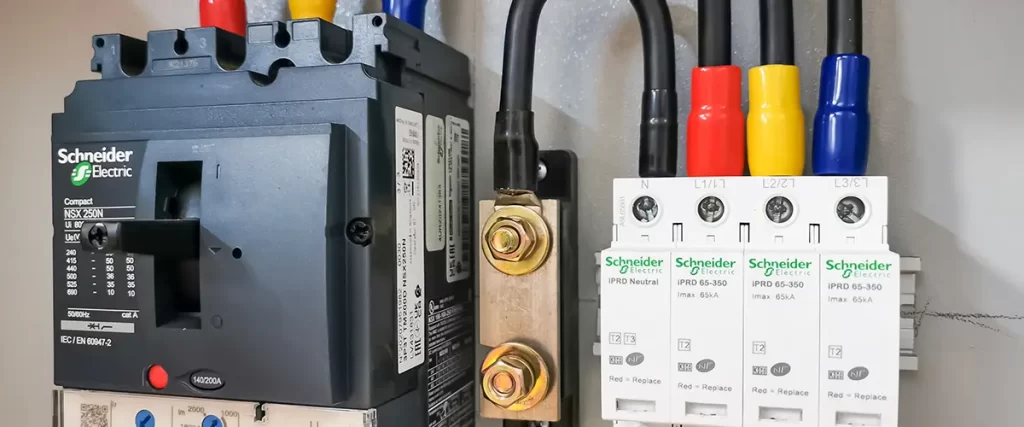
The second layer is a whole-house surge protector wired into your electrical panel, which stops big spikes at the door before they reach an outlet.
It takes a licensed electrician to install, and it should be UL-listed to meet safety and sustainability standards. Our guide to the best whole-house surge protectors compares the best options.
| Plug-in strip | Whole-house protector | |
| Where it goes | one outlet | your electrical panel |
| What it protects | whatever’s plugged in | every circuit in the house |
| Big surges from the grid | limited help | catches them at the door |
| Installed by | you, in a second | a licensed electrician |
Many homeowners assume the circuit breaker covers all this. It doesn’t. A breaker trips on too much current, a different problem from a voltage spike, so it lets a surge sail right past to your electronics.
When a storm rolls through the Valley, the simplest step still helps. The National Weather Service recommends staying away from corded electronics and appliances during a thunderstorm, so unplugging the pricey things you’d hate to replace is good practice.
Power Surge FAQs
Does a surge protector really stop a lightning strike?
Not a direct hit, which carries more energy than any home device can stop. A whole-house protector and solid grounding handle the far more common case, where lightning strikes nearby, and only part of that energy comes down your lines.
How often should I replace a surge protector strip?
Every couple of years is a safe rule, sooner if it’s been through a major storm. Many strips have an indicator light that goes dark when the protection is spent, so if that light is off, the strip is done even though the outlets still work.
Do I still need whole-house protection if I already use power strips?
Yes. Strips guard one spot at a time and can’t stop a big surge off the grid. The whole-house unit takes the large incoming hits, and the strips back it up at your most sensitive electronics.
The Next Storm Doesn’t Have to Cost You a Single Device
If your lights flicker when the AC kicks on, or you’ve already lost a device or two to a spike, a panel setup is the fix.
We handle surge protection installation across the Lehigh Valley, and we’re glad to walk your panel and tell you honestly what it needs.
Call us at (610) 214-2179 or message us here.